
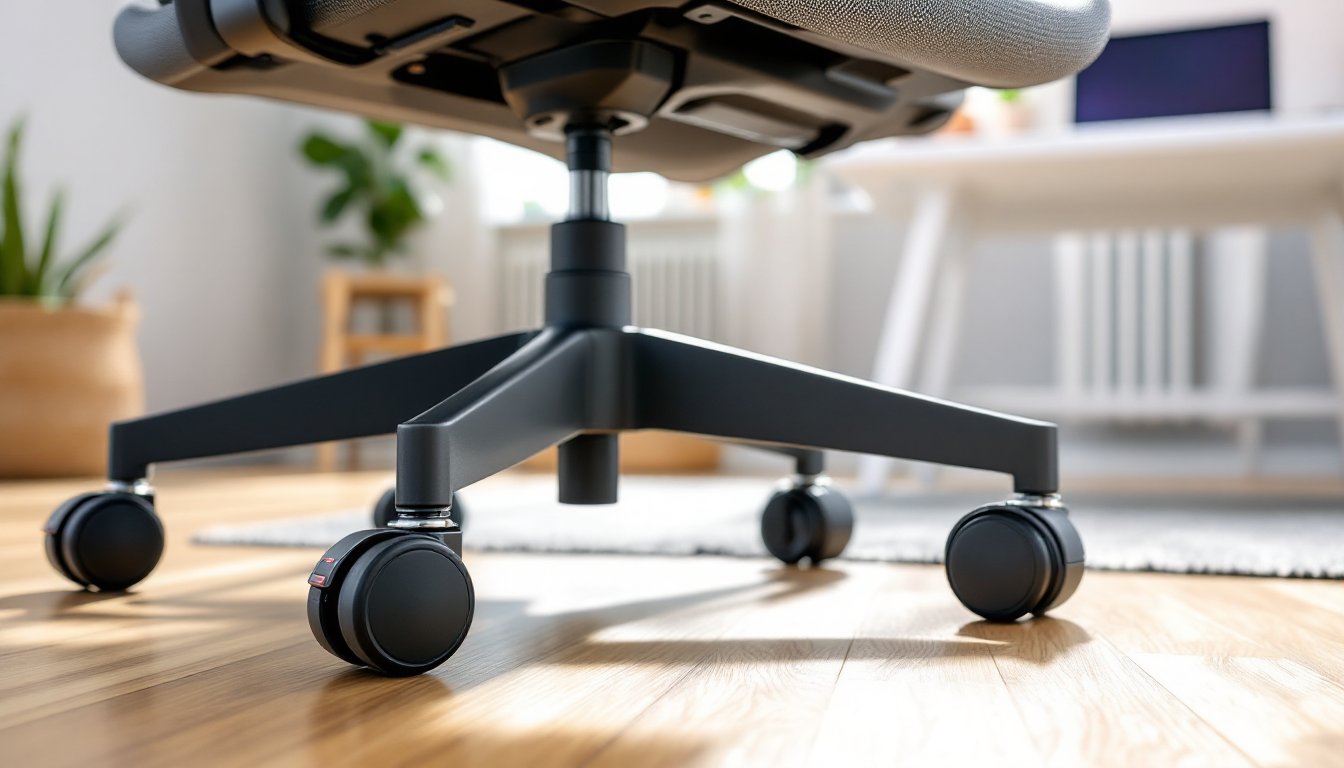
Rolling across the room mid-task isn’t just annoying, it’s a safety hazard. Whether someone’s reaching for a file, typing at a standing-height desk, or simply needs their chair to stay put on a slope, locking wheels solve a real problem. Unlike standard casters that roll freely, locking mechanisms give users control over when their chair moves and when it doesn’t. This matters for home offices with uneven floors, workshops where stability is critical, and spaces where a runaway chair could cause injury. This guide covers how locking casters work, what types are available, and how to choose or install them without calling in a pro.
Table of Contents
ToggleKey Takeaways
- Locking wheels on office chairs prevent unintended rolling on hard floors, sloped surfaces, and uneven terrain, reducing safety hazards and protecting flooring from scratches.
- Two main types of locking mechanisms exist: mechanical locks (lever or button-activated) and pressure-activated systems that engage automatically when weight is applied, with dual-lock casters providing the most stability by immobilizing both the wheel and swivel stem.
- An office chair with locking wheels requires proper matching of stem type (threaded or grip-ring), load rating, and caster height to ensure compatibility and prevent ergonomic issues.
- Installing or upgrading to locking wheels is a straightforward DIY task that requires no specialized tools for grip-ring stems and only basic hand tools for threaded casters, with the process taking less than 15 minutes per wheel.
- For budget-conscious upgrades, a two-lock three-free setup on rear casters provides practical stability for level floors while maintaining maneuverability, though slopes or precision tasks require full dual-lock systems.
Why Locking Wheels Matter for Your Home Office Chair
Most office chairs come with standard swivel casters that roll in every direction. That’s fine for carpet or level floors, but it becomes a liability in certain situations. Hardwood, tile, or polished concrete offer almost zero resistance, and even a slight shift in weight can send the chair gliding backward. For anyone working on a sloped floor, common in older homes or basement offices, gravity does the rest.
Locking wheels eliminate that drift. They’re essential for tasks requiring stable body positioning: soldering, detailed drafting, using a microscope, or operating foot-pedal equipment. They also reduce fall risk for users with mobility challenges who need the chair to stay stationary while transferring in and out.
Beyond safety, locking casters protect flooring. Chairs that roll uncontrollably can scratch hardwood or gouge vinyl plank. Locks keep the chair in place during use, then release for repositioning. That control matters in shared spaces, too, kids, pets, and other household members won’t accidentally send an empty chair rolling into a wall or down a hallway.
Another overlooked benefit: noise reduction. Free-rolling casters click and rattle on hard surfaces. Locking them during focused work cuts down on distracting movement and sound, especially in open-plan spaces or home offices adjacent to living areas.
How Locking Casters Work: Understanding the Mechanism
Locking casters use one of two core systems: mechanical locks or weight-activated brakes. Mechanical locks are the simpler design. A lever, button, or twist ring engages a brake pad or pin that jams the wheel’s rotation. These are fail-safe, once locked, the wheel won’t turn unless the user manually disengages it.
The brake pad presses against the wheel tread, creating friction. Cheaper models use plastic pads that wear down quickly on hard floors. Better casters feature rubber or polyurethane pads that grip without damaging the wheel or losing effectiveness after a few dozen cycles.
Some designs lock the swivel stem instead of (or plus to) the wheel. This prevents the caster from rotating around its vertical axis, which stops side-to-side drift but still allows forward-backward roll if only the stem is locked. Dual-lock designs address this by securing both the wheel and the swivel, fully immobilizing the chair.
Weight-activated systems, sometimes called pressure-sensitive or load-responsive casters, work differently. They lock automatically when weight is applied and release when the user stands up. A spring-loaded mechanism inside the caster housing pushes brake pads outward against the wheel when compressed. These are popular in healthcare and industrial settings but less common in consumer office chairs due to higher cost and complexity.
Most DIYers will encounter screw-in stem casters (7/16″ x 7/8″ or 11mm x 22mm threads) or grip-ring stem casters (friction-fit). Locking mechanisms add about 1/4″ to 3/8″ of height compared to standard casters, which can affect chair ergonomics if mixing locked and non-locked wheels.
Types of Locking Wheel Systems for Office Chairs
Dual-Lock Casters
Dual-lock casters immobilize both the wheel and the swivel stem with a single control. A foot-operated lever or hand-twist collar engages both mechanisms simultaneously. This is the gold standard for true stability, the chair won’t roll, pivot, or drift in any direction.
They’re ideal for sloped floors, workshops, or medical offices where a chair must stay exactly where it’s placed. The tradeoff is weight and cost. Dual-lock casters often have reinforced housings and cost $8–$15 per wheel (compared to $3–$6 for standard locking wheels). They also require more clearance under the chair base, check that the chair’s five-star base has enough ground clearance if you’re retrofitting.
Most dual-lock designs use a side-mounted toggle lever. Tap it down with your foot to lock, tap again to release. Some models include color-coded indicators (red = locked, green = free) so users can see status at a glance. This is a nice feature in shared spaces or for users with limited mobility who can’t easily bend to check.
Pressure-Activated Locking Wheels
Pressure-activated (or auto-locking) casters engage when the user sits and disengage when they stand. No manual control is needed. A spring-loaded plunger inside the caster housing pushes brake pads against the wheel under load. When weight is removed, the spring retracts and the pads release.
These are best for users who forget to manually lock their chair or need hands-free operation. They’re common in task chairs used in labs, clinics, or industrial settings where workers frequently stand and sit. For someone building a home workshop, pressure-activated casters can prevent the chair from rolling away while reaching for tools or parts.
Downsides: they’re more expensive ($12–$20 per wheel), heavier, and less common in consumer channels. They also require consistent weight distribution, if someone leans heavily to one side, some wheels may unlock while others stay braked, causing uneven drag. And they’re overkill for most home offices unless mobility or safety is a specific concern.
Installation is identical to standard casters. Just confirm the stem type (threaded or grip-ring) and load rating. Most office chairs are rated for 250 lbs: upgrade to commercial-grade casters (300–350 lb rating) if the combined weight of user and chair exceeds that.
Choosing the Right Office Chair With Locking Wheels for Your Space
Start with your flooring. Hard surfaces (tile, hardwood, laminate) need casters with soft, non-marking treads, polyurethane or rubber. Hard plastic wheels will scratch and make noise. For carpet, harder wheels roll more easily, but if you’re locking the chair in place most of the time, tread hardness is less critical.
Next, measure the stem diameter and type. Pull a caster out of your existing chair. Threaded stems have visible metal threads and screw into a brass or steel insert in the chair base. Grip-ring (or friction-fit) stems have a smooth shaft with an expanding collar that wedges into the base socket. Use calipers or a ruler: common sizes are 7/16″ diameter (threaded) or 7/16″ and 3/8″ (grip-ring). Mixing stem types won’t work, threaded casters need threaded sockets.
Load rating matters if the chair will support more than 250 lbs (user + chair weight). Industrial-grade casters are rated to 300–350 lbs and have thicker axles and reinforced housings. Check the fine print, some budget locking casters are rated for only 150–200 lbs per wheel and will fail under normal use.
Consider how often the lock will be used. If it’s a daily, all-day lock, invest in metal-gear mechanisms rather than plastic. Plastic levers and pawls wear out quickly with repeated use and can jam or break within months. Metal components cost more upfront but last years.
For home offices on a budget, a two-lock / three-free setup is a practical compromise. Lock the two rear casters for stability while seated, and leave the front three free for easy repositioning. This works on level floors but isn’t sufficient for slopes or high-precision tasks.
Finally, match the caster height to your chair. Adding locking casters can raise the seat height by 1/4″ to 1/2″. If your chair is already at maximum extension, this could push it out of ergonomic range. Low-profile locking casters exist but are harder to find and more expensive.
Installing or Upgrading to Locking Wheels: A DIY Guide
Swapping casters is one of the simplest furniture upgrades, no tools required for grip-ring stems, and just pliers for stubborn threaded ones. Work on a drop cloth or cardboard to protect the floor, and wear work gloves if the old casters are greasy or sharp.
Step 1: Tip the chair on its side or flip it upside down. A folded towel under the seat back prevents scratches.
Step 2: For grip-ring casters, grip the wheel firmly and pull straight out. If it’s stuck, wiggle while pulling or use a flathead screwdriver to pry gently at the base of the stem collar. Don’t pry against the chair base itself, it’s often plastic and will crack.
Step 3: For threaded casters, turn counterclockwise. If hand pressure isn’t enough, use locking pliers or a pipe wrench on the wheel housing (not the wheel itself). A few drops of penetrating oil (PB Blaster, WD-40) will loosen rusted threads. Let it sit five minutes before trying again.
Step 4: Clean the socket holes with a rag or paper towel. Remove dust, hair, and debris. Inspect for cracks, if the chair base is cracked around the socket, it won’t hold the new caster securely and should be replaced (bases run $15–$40 and are widely available online).
Step 5: Insert the new caster. For grip-ring stems, push firmly until you hear or feel a click. It should not pull out with moderate hand force. For threaded stems, turn clockwise until snug, don’t overtighten or you’ll strip plastic threads.
Step 6: Flip the chair upright and test. Sit in the chair, then try to roll. Engage the locks and push hard in all directions to confirm they hold. If a lock slips or the chair still drifts, remove that caster and check for debris in the mechanism or a bent stem.
Pro tip: If you’re upgrading only some casters to locking versions, put them on the rear two wheels for typing and desk work. This mimics a photographer’s tripod, stable at the back, maneuverable at the front. For someone looking to pair their workspace with comfortable seating options, this partial upgrade is cost-effective and functional.
Locking casters also work on shop stools, workbenches, and even some furniture. DIYers building custom pieces can find plans for sturdy seating with integrated casters that benefit from locks in mobile workshops. And if you’re setting up a multi-use space, beginner-friendly project guides often include tips on choosing the right hardware for movable furniture.
Safety note: If the chair is used by children or elderly users with balance issues, test the locks under real-world conditions before relying on them. Some budget models require firm foot pressure to engage and may not be intuitive for all users.