Poor lighting doesn’t just strain eyes, it tanks productivity and makes every Zoom call look like it’s shot in a basement. Whether you’re converting a spare bedroom or carving out a corner of the living room, overhead lighting is the foundation of a functional workspace. The right ceiling fixture eliminates shadows on the desk, reduces glare on screens, and sets the tone for focus. This guide walks through fixture types, selection criteria, and installation realities so homeowners can light their home office properly the first time.
Table of Contents
ToggleKey Takeaways
- Proper home office ceiling lighting reduces eye strain, improves video call quality, and boosts productivity by providing even ambient illumination across the entire workspace.
- Aim for 50 to 75 lumens per square foot and choose fixtures with cool color temperatures (4000K to 5000K) during work hours and CRI 90+ for accurate color rendering in video calls and color-critical tasks.
- Recessed lights work best for modern, clean aesthetics; flush mounts are ideal for quick upgrades; and pendant lights add visual interest in rooms with 9-foot ceilings or higher.
- Smart dimmers and tunable bulbs allow flexibility to shift between focused task lighting and evening wind-down modes, supporting varied work schedules in a home office.
- DIY ceiling lighting installation is straightforward for flush-mount replacements on existing boxes, but recessed lights, new circuits, and heavy pendant installations require careful planning, proper tools, or a licensed electrician to ensure NEC compliance and safety.
Why Ceiling Lighting Matters in Your Home Office
Ceiling lighting provides ambient illumination, the base layer that fills a room evenly and prevents harsh contrasts. Without adequate overhead light, desk lamps alone create isolated pools of brightness that force the eyes to constantly adjust between light and dark zones, leading to fatigue within a couple of hours.
A well-lit ceiling fixture also improves video call quality. Overhead light reduces under-eye shadows and evens out skin tones better than a desk lamp aimed from one side. For anyone spending hours on virtual meetings, this isn’t cosmetic, it’s professional.
Proper ceiling lighting also affects mood and alertness. Studies consistently link cooler color temperatures (4000K to 5000K) with increased focus during daytime work hours, while warmer temps (2700K to 3000K) help wind down. Adjustable fixtures give flexibility to shift between task mode and evening hours. Many home office design choices prioritize aesthetics, but lighting directly impacts how well someone can work in the space day after day.
Finally, ceiling fixtures free up desk real estate. A solid overhead setup means fewer cords, less clutter, and more room for monitors, paperwork, or whatever the workflow demands.
Types of Ceiling Lights for Home Offices
Recessed Lighting and Can Lights
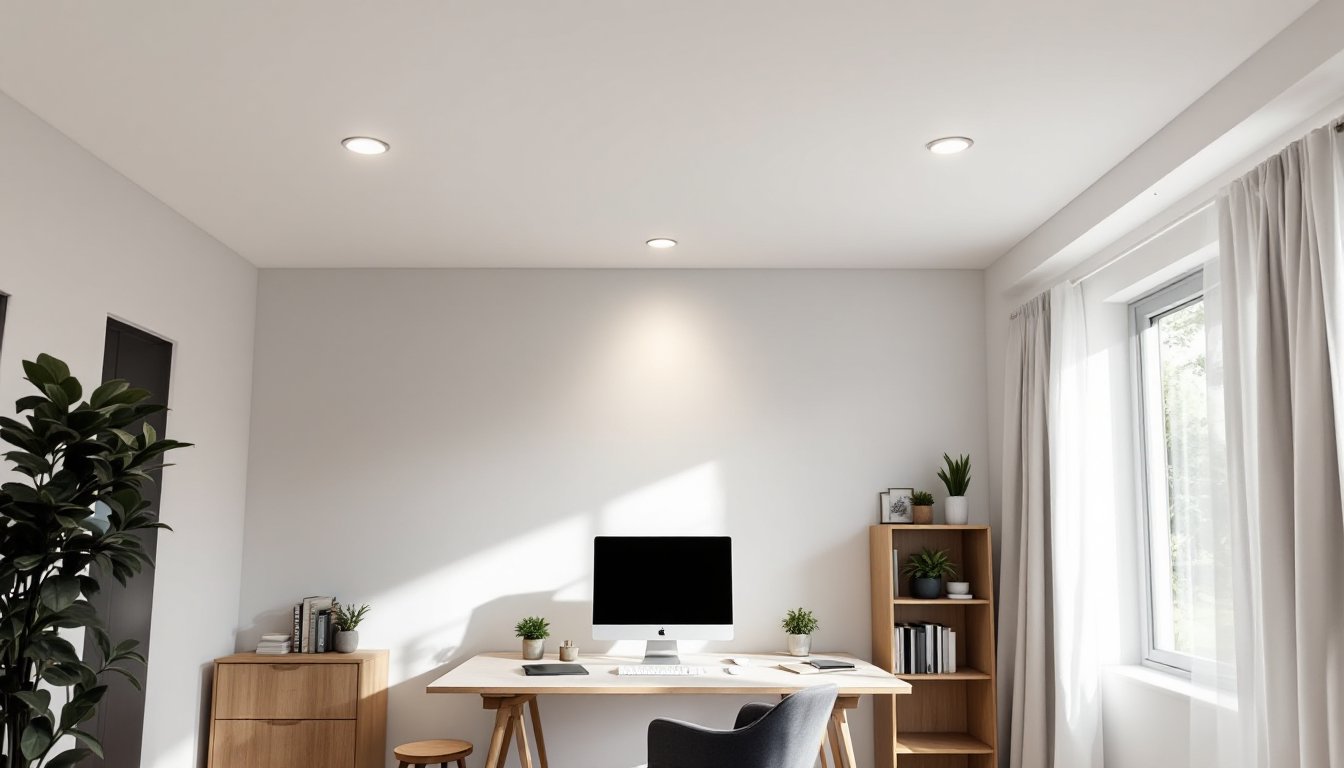
Recessed lights (often called can lights or pot lights) sit flush with the ceiling and direct light downward in a cone-shaped beam. They’re common in modern builds and remodels because they provide clean, unobtrusive coverage.
Pros: Low-profile design works in rooms with standard 8-foot ceilings or lower. They distribute light evenly when spaced correctly, typically one fixture per 25 to 30 square feet for general lighting. Dimmable LED retrofit kits make it easy to adjust brightness.
Cons: Installation requires cutting into the ceiling and working around joists, which means drywall patching and paint touch-ups. If the ceiling is already finished, expect a messy job. Also, poorly aimed cans create glare on monitors. Angled or adjustable trims help direct light away from screens.
Best for: Clean, modern aesthetics and spaces where you want lighting that disappears visually. Pair with task lighting for zones that need extra brightness.
Flush Mount and Semi-Flush Mount Fixtures
Flush mount fixtures attach directly to the ceiling with minimal or no gap, while semi-flush mounts hang down a few inches on a short stem. Both styles house the bulb(s) within a shade or diffuser.
Pros: Easier to install than recessed lights, most mount to a standard ceiling electrical box with just a few screws. They spread light broadly, and frosted or opal glass diffusers reduce harsh shadows. Homeowners working on small office setups appreciate the simple swap from an old fixture.
Cons: Bulky designs can feel dated, and cheaper models with clear or thin shades create glare. Check the fixture’s lumen output, many decorative flush mounts prioritize style over adequate brightness and leave a room dim.
Best for: Quick upgrades, rental-friendly installations, and rooms where running new wiring isn’t an option. Look for fixtures rated for LED bulbs at 1500 to 2500 lumens for a typical 100- to 150-square-foot office.
Pendant Lights and Chandeliers
Pendant lights hang from the ceiling on cords, chains, or rods, suspending the light source lower into the room. Chandeliers are multi-arm versions, often more decorative.
Pros: Pendants add visual interest and can be positioned directly over a desk for focused ambient light. Adjustable-height models let you dial in the right drop. According to House Beautiful, pendant fixtures are trending in home offices for their blend of function and style.
Cons: They eat up vertical space, which is a problem in rooms with low ceilings. Hanging a pendant too low creates head-knock hazards or blocks sightlines. They also concentrate light in one zone, fine over a desk, but the rest of the room may need supplemental fixtures.
Best for: Rooms with 9-foot or higher ceilings, or desks positioned away from traffic paths. Use a pendant with a diffuser or shade that directs light downward and sideways to minimize glare on the work surface.
How to Choose the Right Ceiling Light for Your Home Office
Start with lumens, not watts. Watts measure energy consumption: lumens measure light output. For office work, aim for 50 to 75 lumens per square foot. A 120-square-foot room needs 6,000 to 9,000 lumens total from all sources. A single ceiling fixture rarely hits that alone, so plan on layering with desk or floor lamps.
Next, consider color temperature. Measured in Kelvin (K), this determines whether light looks warm (yellowish) or cool (bluish). 4000K to 5000K (neutral to cool white) mimics daylight and keeps alertness high during work hours. 2700K to 3000K (warm white) is better for evening wind-downs but can feel too cozy for focused tasks. Many smart bulbs and fixtures now offer tunable white, allowing shifts throughout the day, useful for anyone pulling varied hours in a home office.
Color Rendering Index (CRI) also matters. CRI rates how accurately a light source shows true colors, on a scale of 0 to 100. For video calls, reading documents, or any color-critical work, choose bulbs with CRI 90 or higher. Cheap LEDs often sit around 80, which makes skin tones look sickly and can distort color on printed materials.
Check the fixture’s beam angle if using recessed or track lights. Narrow beams (25 to 40 degrees) create spotlighting, which is dramatic but not ideal for even workspace coverage. Wide flood beams (80 to 120 degrees) spread light more evenly. Resources like Tom’s Guide regularly compare LED bulbs and smart fixtures for home office use.
Finally, factor in dimming capability. Not all LED bulbs or fixtures dim smoothly, some flicker or cut out at low levels. If installing a dimmer switch, confirm the bulbs are labeled “dimmable” and check compatibility with the switch type (leading-edge vs. trailing-edge). This is especially important for anyone toggling between deep-focus tasks and casual screen time.
Don’t ignore room size and ceiling height. A single pendant works in a 10×10 space, but a 12×15 room likely needs multiple fixtures or a higher-output flush mount. For ceilings above 9 feet, semi-flush or pendant styles prevent the light from feeling too distant. Standard 8-foot ceilings do best with flush mounts or recessed lights to avoid crowding the visual space.
Installation Tips and DIY Considerations
Turn off the circuit breaker before touching any wiring. Confirm power is off with a non-contact voltage tester, don’t rely on the wall switch alone. Electrical work falls under National Electrical Code (NEC) standards, and many jurisdictions require permits for new circuits or recessed can installations. If adding a new fixture to an existing box, a permit usually isn’t needed, but confirm local rules.
Flush and semi-flush mount swaps are straightforward DIY jobs if there’s already a ceiling box in place. The old fixture comes down, the new one goes up. Match wire colors: black (hot) to black, white (neutral) to white, and bare copper or green (ground) to the ground screw or wire. Use wire nuts rated for the gauge, typically 14 AWG or 12 AWG in residential wiring. Tighten the mounting screws to the box, then attach the canopy or shade. Test the fixture before finishing.
Recessed light installation is more involved. If the ceiling is open (during new construction or a remodel), it’s straightforward: cut holes with a hole saw, run NM-B cable between cans, secure IC-rated housings between joists, and wire everything to the switch. If working in a finished ceiling, you’ll need to fish wire through the attic or crawl space, which can be tight and dusty. New-construction housings won’t work here, use remodel cans with spring clips that grab the drywall. Expect drywall dust and plan for touch-up painting. Many smart home enthusiasts, as noted by Digital Trends, are now installing smart recessed LEDs that integrate with voice assistants and offer tunable color temperatures.
Pendant lights require a ceiling box rated for the fixture’s weight. Standard pancake boxes hold up to 50 pounds, but heavier chandeliers need a fan-rated or heavy-duty box anchored to a joist or blocking. If there’s no box where you want the pendant, running new wire is a job for a licensed electrician unless you’re comfortable working with NM cable, junction boxes, and code-compliant stapling intervals.
Safety notes: Wear safety glasses when drilling overhead, drywall dust and debris will rain down. Use a sturdy ladder or scaffolding, not a chair or wobbly step stool. If the fixture is heavy, get a helper to hold it while you wire. And if the circuit is shared with other rooms or keeps tripping the breaker, consult an electrician, you may need a dedicated 15-amp circuit for the office.
Tool checklist:
- Non-contact voltage tester
- Wire strippers and cutters
- Screwdrivers (flathead and Phillips)
- Drill with hole saw (for recessed cans)
- Fish tape (if running new wire)
- Ladder tall enough to work comfortably
When to call a pro: If the ceiling has no existing electrical box, if you’re unsure about load calculations, or if local code requires a licensed electrician’s signature, don’t wing it. Electrical fires from improper installations are real, and homeowner’s insurance may deny claims if unpermitted work is discovered. For complex layouts or two-person office spaces that need multiple circuits, a pro ensures everything is wired safely and to code.
For finishing touches, consider pairing ceiling fixtures with smart switches or dimmers. This adds flexibility without replacing bulbs every time technology shifts. Many office design strategies now incorporate lighting control as part of the overall productivity plan, not just an afterthought.